

From the experts at Phoenix Phase Converters – helping shops run 3-phase equipment for over 20 years.
Whether you're wiring a motor to utility three-phase power or connecting it to a rotary phase converter, these diagrams will guide you through proper lead connections.
Three Phase – 12 Lead Motor
Most versatile configuration – can be wired for dual voltage (typically 230V/460V)

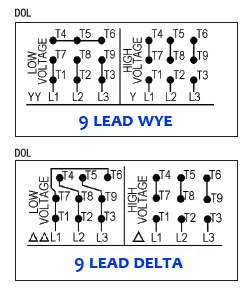
Three Phase – 9 Lead Motor
Common on dual-voltage motors – can be configured for high or low voltage
Three Phase – 6 Lead Motor
Single voltage, straightforward wiring – what you see is what you get

Three Phase – 3 Lead Motor
Simplest connection – single voltage only, no configuration options

Need to Run These Motors on Single-Phase Power?
If you don't have 3-phase utility service, a rotary phase converter from Phoenix Phase Converters lets you run any three-phase motor from standard single-phase power.
We're here to help:
- 📞 Call us for free sizing assistance
- 🛠️ We'll match you with the right converter for your motor
- 📦 Fast shipping on in-stock units
Understanding Motor Lead Configurations
The number of leads on your three-phase motor determines your wiring options. Motors with more leads (9 or 12) offer voltage flexibility, allowing you to wire them for either high or low voltage depending on your power supply. This is especially useful when pairing motors with phase converters, as you can optimize for your specific single-phase input voltage.
At Phoenix Phase Converters, we've helped thousands of customers properly size and connect their three-phase motors. Whether you're setting up a machine shop, woodworking facility, or industrial operation, our American-made rotary phase converters deliver clean, balanced power to keep your motors running smoothly.
Questions about wiring your motor to a phase converter? Give us a call – we're happy to walk you through it.


