
20 HP Rotary Phase Converters
Compare every 20 HP phase converter Phoenix manufactures — rotary, AutoStart, AutoLink, digital static, and transformer packages — built in the USA with a lifetime warranty. Free sizing help from real engineers at 800-417-6568.
The 20 HP rotary phase converter is our best-selling size because most production shops are built around motors in the 7.5–15 HP range. A 20 HP converter handles that mix with capacity to spare — powerful enough to start a 10 HP lathe or a 7.5 HP air compressor, but not so oversized that you're paying for iron you'll never use. Job shops, small machine shops, wood products manufacturers, and agricultural operations converting from utility three-phase almost always land here.
Application Guide
Will a 20 HP rotary phase converter run my equipment?
The answer depends on the horsepower of your largest single motor and how hard that motor is to start. Phoenix rates converters using four load categories — Easy, Medium, Hard, and Very Hard — because identical nameplate HP can mean very different starting currents depending on the machine type.
Single 15 HP CNC spindle (mill or lathe) — No, step up
CNC spindle motors require a converter rated at roughly 2× the spindle horsepower because of the high inrush and continuous high-torque load profile. A 15 HP CNC spindle needs a 30 HP converter — not the 20 HP. Step up to our 30 HP rotary phase converter. The 20 HP GP20NL is the right choice when your largest CNC spindle is 10 HP or smaller.
Single 10 HP CNC lathe with auxiliary loads — Yes
A 10 HP lathe motor is a Hard load (lathes, brakes, shears, and hydraulic pumps all fall here). The GP20NL's maximum Hard-load start rating is 10 HP — the exact ceiling. You can run the lathe plus low-amp auxiliaries like coolant pumps and chip conveyors simultaneously, as long as you don't start a second large motor during the lathe's startup surge.
7.5 HP rotary screw compressor plus small running loads — Yes
Air compressors are Very Hard loads because they start under back-pressure. The GP20NL is rated for a maximum 7.5 HP compressor. A 7.5 HP rotary screw at roughly 22 A continuous is well within the converter's 54 A inductive output ceiling. While the compressor runs, you can simultaneously operate drill presses and small mills.
10 HP dust collector plus small machines — Yes
Dust collectors are Medium loads (like mixers, band saws, and hoists). The GP20NL handles Medium loads up to 12 HP, so a 10 HP dust collector fits with room to spare. While the collector runs, you can also run a shaper, widebelt sander, or planer — provided they don't all start simultaneously.
15 HP mill plus 5 HP compressor — Yes, but NOT at the same time
Both machines can operate independently on the GP20NL. What you cannot do is start them at the same instant — simultaneous inrush from two motors spikes well beyond the converter's starting capacity. Wire both to the converter output and let the compressor's auto-cycle and the machine's normal cutting cycle stagger themselves naturally. In practice, that is how most shops already operate.
Full 20 HP single motor across-the-line — Caution
A 20 HP motor started direct-on-line exceeds the converter's rated starting capacity. If the motor has a soft-starter or VFD that limits inrush, the GP20NL may handle it — but confirm first with our engineering team at 800-417-6568. Across-the-line starts at 20 HP on a 20 HP converter will likely cause nuisance trips or idler stress.
Two 10 HP CNCs running simultaneously — No
Two 10 HP Hard-load machines running together under full cutting load pushes the GP20NL to its absolute ceiling. For two concurrent 10 HP Hard loads, step up to the 25 HP converter for the headroom you need.
Not seeing your specific machine above? Call us at 800-417-6568 — we size converters for free.
Which Model Is Right for You?
20 HP rotary phase converter buying guide
Phoenix builds seven distinct 20 HP configurations. The differences come down to control features, output voltage, and whether your site needs digital monitoring.
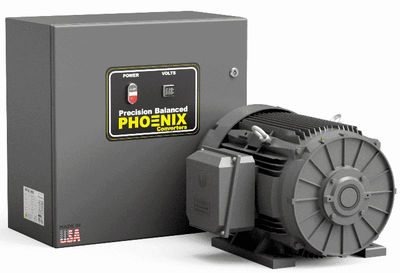
GP20NL — Standard rotary converter ($2,740.51)
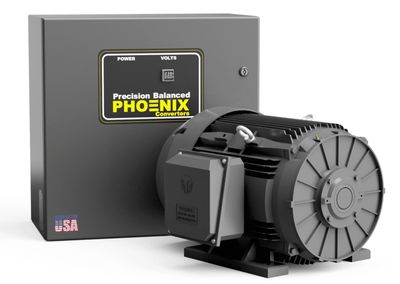
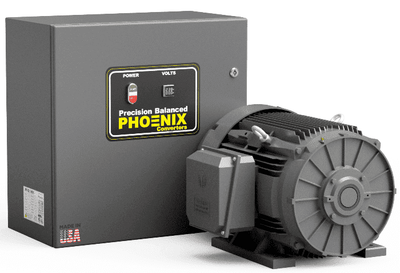
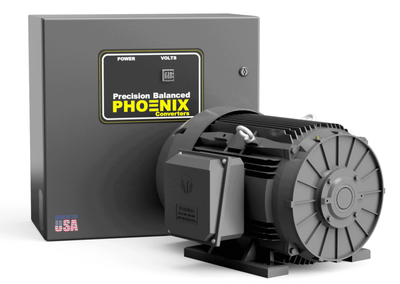
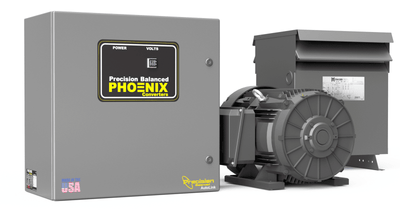
The GP20NL is the right choice for the majority of shops. It runs on 230 VAC single-phase, delivers 230 VAC three-phase output, and holds voltage balance within ±2% — tighter than the ±3% industry standard. The 256T frame cast-iron TEFC idler is built for continuous duty. The NEMA 4 IP66 panel handles dust, coolant mist, and wash-down environments.
Best for: machine shops, woodworking, agriculture, HVAC compressor rooms, auto repair — anywhere you need reliable three-phase for general-purpose motors.
Not ideal for: 460V output requirements, remote/automated start needs, or sites that want real-time energy monitoring.
View full GP20NL specs and order →
GP20PL — Premium rotary converter
The PL upgrade adds additional run capacitance and tighter factory-balanced output. The smaller spread between the generated leg and the utility legs matters when your machines include CNC controls, servo drives, welding power supplies, or other electronics that react to even small voltage asymmetries. If your CNC control throws phase-imbalance alarms, or if you're running arc welders on the same circuit, the GP20PL is worth the price difference. For general-purpose motor loads, the GP20NL's ±2% balance is already more than adequate.
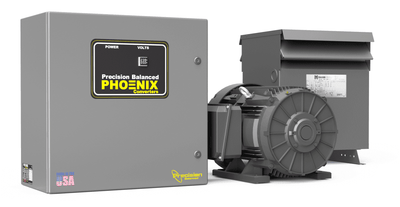
GP20NLT / GP20PLT — Transformer packages (460V output)
Some machines — European imports and certain older American industrial equipment — require 460V three-phase. The NLT and PLT packages bundle a matched step-up transformer with the rotary converter so you feed 230V single-phase in and get 460V three-phase out. Buying a package eliminates sizing guesswork and ensures the transformer is matched to the converter's output. Choose NLT for general-purpose 460V loads; choose PLT if CNC or sensitive electronics are in the mix.
GP20NH — 460V input to 460V output (rare)
Designed for the uncommon situation where your utility delivers 460V single-phase — occasionally found in older industrial districts. Almost all US residential and light-commercial services are 120/240V. If you're unsure, check your utility meter before ordering. If you do have 460V single-phase, the NH is the only correct choice in the 20 HP lineup.
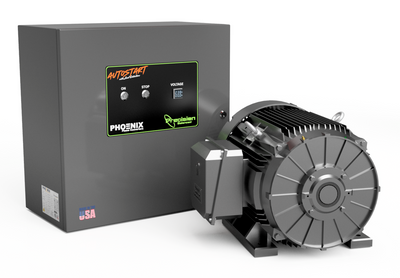
GP20ASL — AutoStart with remote capability
The AutoStart sensing relay starts and stops the converter automatically when your machines call for three-phase power. The factory default shutdown timer is 20 minutes — long enough to bridge normal machine pauses without cycling the idler constantly. AutoStart is most valuable in automated production cells and in shops that want to minimize no-load idler run time for energy and wear reasons.
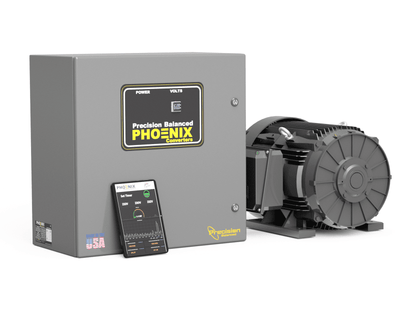
GPX20L / GPX20ASL — Digital converter with energy monitoring
The GPX series adds a built-in energy monitor, internet remote control, and 7-day scheduling to the rotary platform. Watch real-time kW draw, check voltage balance, and review run hours from a web browser or mobile app. The 7-day scheduler automatically starts the converter before your shift and shuts it down after. GPX20ASL combines digital monitoring with the AutoStart relay. If your facility tracks energy consumption or needs remote diagnostics, the GPX platform pays back in operational visibility.
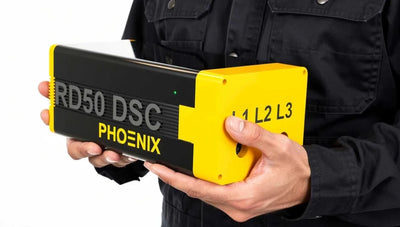
RD1080 — 20 HP digital static converter
The RD1080 is a digital static (capacitor-start) unit, not a rotary. It runs one motor at a time, limits motors to roughly two-thirds of rated capacity under load, and is not suitable for CNC applications. It is the right choice for a single, light-duty, non-CNC motor in a budget-constrained situation.
The Technology
How a 20 HP rotary phase converter works
Single-phase power delivers two conductors at 230 VAC — enough for lighting and single-phase motors, but not the three-conductor system industrial motors require. A rotary phase converter bridges that gap by generating a synthetic third leg from the two legs you already have.
At the heart of the GP20NL is an idler motor: a three-phase induction motor running without a mechanical load. When single-phase power is applied to two of its terminals, the start capacitors produce enough phase shift to spin the rotor. Once spinning, the rotor's rotating magnetic field generates voltage on the third terminal — your new third phase leg. Run capacitors trim the generated leg's voltage and phase angle to hold the ±2% balance spec across all three output terminals.
Why the idler frame size matters
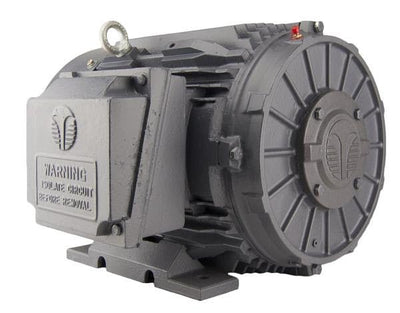
Phoenix uses a 256T frame cast-iron TEFC motor as the idler. Frame 256T is a NEMA designation for a specific shaft height and body diameter — a genuine industrial motor. Cast iron absorbs and dissipates heat better than aluminum housings, which matters because the idler runs continuously during shop operation. The TEFC design moves cooling air over the finned frame without exposing windings to dust, coolant, or debris. Properly framed industrial idlers last decades; undersized idlers in aluminum frames run hot and fail early.
Rotary versus static converters
Static converters use capacitors alone. They generate the third leg only at startup; under running load the third leg droops, limiting motors to roughly 67% of rated capacity and ruling out simultaneous multi-motor loads. Rotary converters maintain a live third leg continuously and can support multiple loads at once.
Rotary versus digital (VFD-based) converters
Digital phase converters synthesize three-phase output through VFD electronics and handle light loads efficiently, but frequently trip their over-current protection on high-inrush motor starts where locked-rotor current spikes to five to seven times running amps. Rotary converters absorb that inrush through the spinning idler's mass and magnetic characteristics — no electronics to trip, no fault to clear.
For a detailed look at measuring and maintaining voltage balance, read our guide: How to Balance the Output Voltage of a Rotary Phase Converter.
Before You Install
Electrical and physical installation requirements
A 20 HP rotary phase converter draws substantial current from your single-phase service. Getting the installation right the first time prevents nuisance trips, overheating, and equipment damage.
Service panel and breaker sizing
Per NEC Table 430.250, a 20 HP three-phase motor at 230V draws 54 A full-load on the three-phase side. On the single-phase input side, the converter draws roughly twice that — approximately 108 A at full load — because all the power flows through two conductors instead of three. The GP20NL specifies a maximum breaker of 100 A and a minimum of 40 A. A 100 A motor-rated (Type MG) breaker is the right choice for most installs. Standard thermal-magnetic breakers can nuisance-trip on motor starting inrush; use a motor-load rated breaker.
Wire size
The GP20NL requires a minimum 4 AWG copper conductor for the single-phase line input. Between the idler motor and the control panel, use minimum 6 AWG copper. These are Phoenix's published minimums for normal run lengths. If your run from the panel to the converter exceeds 50 feet, consult our single-phase wire size chart or have your electrician calculate voltage drop for the actual distance. Undersized wire causes voltage sag that the converter cannot compensate for.
Grounding
Install a dedicated equipment ground per NEC Article 250. Do not rely on conduit as a ground path. A solid equipment ground protects the converter and downstream machines and is required for UL 508A compliance.
Physical location and mounting
The GP20NL idler weighs 330.75 lb; the control panel weighs 37 lb. Mount on a concrete floor or a structure rated for the combined weight and vibration. The NEMA 4 IP66 enclosure handles outdoor and wash-down environments, but an indoor install in a dry location extends capacitor and contactor life. The TEFC fan cools the motor — keep the area open, not sealed.
Distance from machines
Every additional foot of wire between the converter output and your machine adds resistance and voltage drop. Keep output runs under 50 feet where possible. For longer runs, upsize the output wire by one or two AWG gauges and verify against the wire size chart.
Hire a licensed electrician. This installation involves 100 A+ circuits at 230 V and a 330 lb motor. It is not a DIY project. Call 800-417-6568 — our team walks electricians through the installation at no charge.
Electrical Specs Explained
Voltage, amperage, and load capacity: the numbers behind the GP20NL
NEC full-load amp reference
NEC Table 430.250 lists a 20 HP three-phase motor at 230V as drawing 54 A FLA. At 460V, the same motor draws 27 A FLA (current halves when voltage doubles). The GP20NL's maximum inductive output of 54 A matches that NEC reference exactly — confirming the converter is sized to run one full 20 HP motor at rated continuous current.
Single-phase input current
All of the converter's power flows through two single-phase conductors. To supply 54 A of three-phase output, the single-phase input draws roughly 108 A. This is the fundamental reason a 100 A breaker and 4 AWG minimum input wire are required. The math: \(P = \sqrt{3} \times V \times I_{3\phi}\) on the three-phase side equals \(V \times I_{1\phi}\) on the single-phase side, yielding approximately double the three-phase FLA.
Starting inrush
When a motor starts direct-on-line, locked-rotor current spikes to five to seven times FLA. For a 10 HP lathe motor at 230V (roughly 28 A FLA), that means approximately 110–196 A momentarily. The GP20NL's idler and capacitor bank absorb this and restabilize the generated leg within fractions of a second. Starting inrush — not continuous running — is why the per-motor starting rating is lower than total running capacity.
Inductive versus resistive loads
The GP20NL's 54 A inductive maximum applies to motors and transformers. Its separate 28 A resistive maximum applies to electric ovens, resistance welders, battery chargers, and transmitters. Resistive loads draw in a different waveform pattern. If your application is primarily resistive, verify you are within the 28 A ceiling before ordering.
Voltage balance
The industry standard for CNC-grade rotary converters is ±2–3% voltage balance across the three output phases. Phoenix achieves ±2%. Even small imbalances matter: a 3.5% imbalance causes uneven motor winding heating, reduced torque, premature bearing failure, and — in CNC machines — servo drive alarms and control instability. The ±2% spec means your machines see the cleanest generated three-phase voltage a rotary converter can produce.
Where It Gets Used
Common applications for the 20 HP rotary phase converter
Phoenix's 20 HP converter is engineered for these conditions because the load profiles — starting current, continuous duty, and simultaneous operation — all fall within its proven design envelope.
Machine shops and metalworking
CNC mills up to 10 HP (Easy load), CNC lathes up to 10 HP (Hard load), surface grinders, drill presses, and knee mills all run on the GP20NL. Its ±2% voltage balance is what CNC servo drives and spindle inverters require. For a machine-specific breakdown, see our complete guide to phase converters for CNC machines.
Wood product shops
Wide-belt sanders (7.5–15 HP), shapers (5–7.5 HP), thickness planers, and dust collectors (5–10 HP) are among the most common woodworking loads we see on the 20 HP platform. Dust collectors are Medium loads; sanders and shapers run Medium to Hard. A well-configured GP20NL covers a typical woodworking shop's main machine lineup without a second converter.
Agriculture and dairy
Milking vacuum pumps, irrigation boost pumps, grain auger motors, and feed grinder-mixers all run reliably on 20 HP rotary converters — ideal for rural properties with 200 A single-phase service and no three-phase utility nearby.
HVAC and commercial refrigeration
Walk-in cooler condensing units and 7.5 HP commercial AC condensers are Very Hard loads within the GP20NL's 7.5 HP Very Hard ceiling. The NEMA 4 IP66 enclosure handles the wet, dusty mechanical rooms where condensing units live.
Auto repair and granite fabrication
Large two-post lifts, paint booth exhaust fans, and frame straightening equipment use three-phase motors commonly in the 5–15 HP range — a natural fit for the 20 HP converter. Granite saws are Very Hard loads (continuous high torque, abrasive dust); with a motor at or below 7.5 HP, the GP20NL handles the granite shop environment reliably.
How to Size Your Converter
Sizing walkthrough: 10 HP CNC lathe + 5 HP compressor
You own a 10 HP CNC lathe and a 5 HP rotary screw air compressor. Can one GP20NL handle both? Walk through the four steps.
Step 1 — Identify each load and its category
The lathe has a 10 HP spindle motor. Lathes are Hard loads (high starting torque, high locked-rotor current). The GP20NL handles Hard loads up to 10 HP. The 5 HP rotary screw compressor is a Very Hard load; the GP20NL handles Very Hard loads up to 7.5 HP. A 5 HP compressor is well inside that ceiling.
Step 2 — The largest single motor sets the floor
Your converter must be rated to start the largest single motor in its load category. The 10 HP Hard-load lathe is the largest. The GP20NL's Hard-load start rating is 10 HP — exactly matching it. If the lathe were 12 HP, you would need to step up.
Step 3 — Simultaneous starting
Do not plan to start both machines simultaneously. Inrush on the 10 HP lathe alone approaches the converter's starting capacity. Use the compressor's tank to build pressure reserve before the lathe starts, and set the pressure differential wide enough that the compressor rarely kicks in mid-startup.
Step 4 — Steady-state running capacity
At steady state, the combined draw is roughly 28 A (lathe) plus 16 A (compressor) — about 44 A, well inside the 54 A inductive maximum. Steady-state operation is not the constraint; motor starting is.
Conclusion: the GP20NL fits. Order the GP20NL here, or call to confirm your specific lineup.
Still not sure? Call 800-417-6568 — we size converters for free.
Avoid These Before You Order
Five common mistakes when buying a 20 HP phase converter
- Sizing on nameplate HP without checking load type. A 10 HP lathe and a 10 HP drill press both say "10 HP," but the lathe is a Hard load with high starting torque while the drill press is an Easy load. Ignoring load category leads to a converter that nuisance-trips or one you overpaid for.
- Buying a static converter for a CNC machine. Static converters produce an unbalanced generated leg under load. CNC controls, servo drives, and spindle inverters require tight voltage symmetry — within ±3%, and preferably ±2%. A static converter running a CNC machine will cause servo alarms, control faults, and potential electronics damage. Always use a rotary for CNC.
- Undersizing the service panel breaker. The single-phase input draws roughly 108 A at full load. A 60 A or 70 A breaker guarantees nuisance trips under starting loads. Use the 100 A motor-rated breaker the GP20NL specifies.
- Not accounting for simultaneous motor starts. Two motors starting at the same instant doubles the inrush demand. Plan machine sequences so large motors start one at a time, or step up to a larger converter with headroom for concurrent starts.
- Buying lower-cost imports without verifying idler motor quality. Units with undersized or non-TEFC idlers run hot and degrade faster. The GP20NL uses a 256T frame cast-iron TEFC motor certified to UL 508A, CSA C22.2 No. 14-13, TÜV, and CE. Verify frame spec and certifications before any purchase.
Frequently Asked Questions
20 HP rotary phase converter FAQ
1. What's the difference between a rotary and a static phase converter?
A rotary converter uses a spinning idler motor to generate a continuous live third phase leg, allowing multiple motors to run simultaneously at full rated capacity. A static converter uses capacitors alone, generates the third leg only at startup, and limits motors to roughly two-thirds of their nameplate rating under load. Static converters cannot run multiple motors at once and are not suitable for CNC applications.
2. Can a 20 HP rotary converter run multiple motors at the same time?
Yes, within limits. The GP20NL has a total combined run capacity of 20 HP and a maximum inductive output of 54 A. You can run multiple motors as long as their combined running amperage stays within that ceiling and no two large motors start simultaneously. A 10 HP lathe and a 5 HP compressor, for example, can run together at steady state without issue.
3. Do I need 230V or 460V output?
Check the nameplate of each machine. Most US industrial machines accept 208–230V three-phase. European and some older machines require 460V three-phase — choose the GP20NLT or GP20PLT transformer package for those. If your single-phase service is itself 460V (rare), the GP20NH is the correct model.
4. What size breaker do I need?
The GP20NL requires a minimum 40 A and a maximum 100 A motor-rated breaker. Most installations use a 100 A motor-load (Type MG) breaker. Standard thermal-magnetic breakers may nuisance-trip on motor starting inrush at this size; always specify a motor-load rated breaker.
5. Can I run a CNC machine on a 20 HP rotary converter?
Yes — the GP20NL is well-suited for CNC machines with spindle motors up to 10 HP. Its ±2% voltage balance satisfies the phase symmetry requirements of CNC controls and servo drives. For spindles above 10 HP or especially sensitive electronics, the GP20PL or 25 HP tier may be more appropriate.
6. How long does a rotary phase converter last?
A properly installed GP20NL should last 20 years or more under normal shop conditions. The 256T cast-iron TEFC idler motor is a squirrel-cage induction machine with no brushes or commutator — it lasts essentially indefinitely when properly sized and cooled. Capacitors are the most common service item and are inexpensive to replace; Phoenix stocks them.
7. Can I install the converter outdoors?
Yes. The GP20NL control panel is NEMA 4 IP66 rated for rain, dust, and hose-directed water. The idler motor is TEFC — designed for outdoor and dirty industrial locations. Sheltering the unit from direct sun and precipitation extends panel component life; an indoor installation in a heated space is ideal when possible.
8. What are the warranty and return terms?
Phoenix provides full replacement of defective components within the warranty period. Returns are accepted within 90 days in sealed, unopened condition; installed or opened units are not eligible. Call 800-417-6568 for warranty claims.
9. Can I run a 25 HP machine on a 20 HP converter?
Running a motor larger than the converter's rated starting capacity risks a failed start and idler motor stress. If your largest motor is 25 HP, you need the 25 HP converter. The only exception: if the 25 HP motor has a VFD or soft-starter limiting its inrush to within the 20 HP converter's envelope — confirm with our engineering team before ordering.
10. How loud is a 20 HP rotary phase converter?
The 20 HP idler motor produces a low hum similar to any industrial motor — audible in a quiet room, easily masked by shop machinery. The TEFC cooling fan adds moderate airflow noise. In a working machine shop, the converter is a non-issue. It is not suitable for placement in a finished office, but in any standard industrial setting the noise level is unremarkable.
11. Do I need to manually balance the output voltage?
No. Phoenix converters are factory-set to ±2% balance. Verify with a voltmeter after installation under your actual load, but adjustment is rarely needed. If your reading falls outside ±3%, call us for a diagnostic walkthrough.
12. Can I start two large motors at the same time?
Not recommended. Starting two motors simultaneously doubles the inrush demand, which can exceed the converter's instantaneous capacity and cause a trip or failed start. Always start the largest motor first, wait for it to reach running speed, then start secondary motors. If simultaneous starts are unavoidable, call us to discuss oversizing or staggered start relays.
13. What if my equipment has a soft starter or VFD built in?
Built-in VFDs and soft starters limit their own inrush, so the converter sees far lower starting demand — which can allow running a larger machine than the HP rating implies. Some VFD designs are sensitive to the waveform of a rotary-generated leg; call us with your machine's make and model before ordering.
14. Does the AutoStart option save electricity?
Yes, modestly. The idler motor draws no-load current even when no machines are running. The AutoStart relay shuts the converter off after a 20-minute no-load default timer, eliminating that idle draw. In shops that leave the converter running overnight or through lunch breaks, AutoStart meaningfully reduces wasted energy and reduces idler motor run hours.
15. What's the difference between the GP20NL and the GPX20L?
Both use the same 256T frame cast-iron TEFC idler motor. The GP20NL is the standard model with manual switching and no digital features. The GPX20L adds a built-in energy monitor, internet remote control, and 7-day programmable scheduling so you can check voltage, current, and kW draw from your phone. If digital monitoring and remote access matter to your operation, the GPX20L is worth the upgrade; otherwise the GP20NL delivers the same core three-phase power at a lower price.
16. Is professional installation required?
We strongly recommend a licensed electrician — 100 A+ circuits at 230 V and a 330 lb motor on a rated mounting surface. Improper installation can damage the converter, void the warranty, and create a serious hazard. Our engineers provide free installation phone support at 800-417-6568.
17. Can I use this converter in Canada or outside the US?
Yes. The GP20NL carries CSA C22.2 No. 14-13 certification for Canadian installations alongside UL 508A, TÜV, and CE marks. It operates at 50 Hz and 60 Hz, covering most international grid standards. For international shipments, contact us to confirm local code compliance and freight logistics: 800-417-6568.
18. What are the lead time and shipping terms?
Lead times vary by model and stock. Standard GP20NL units typically ship within a few business days when in stock. The idler motor (330.75 lb) ships freight; the control panel (37 lb) may ship ground. You will receive shipping and tracking details at order confirmation. For time-sensitive orders, call 800-417-6568 for current availability.
Our Commitment
Warranty, support, and after-sale service
Every Phoenix converter ships with a full warranty: defective components are replaced within the warranty period. Returns are accepted within 90 days in sealed, unopened condition.
Every converter includes one year of free phone support. If your installation hits a snag or your electrician has a wiring question, call us — our technical team speaks motor and electrical code.
Replacement capacitors, contactors, and control boards are stocked. The GP20NL uses standard industrial components — nothing proprietary. When a capacitor ages out in year 15, a phone call gets you the right part.
The GP20NL carries UL 508A (industrial control equipment), CSA C22.2 No. 14-13 (Canadian electrical code), TÜV, and CE certifications — third-party testing of every circuit and component in the panel. These marks are recognized by insurance carriers and local inspectors.
Ready to Order or Still Have Questions?
Get the right converter the first time
The Phoenix GP20NL is the proven choice for most 20 HP single-phase conversion needs: $2,740.51, UL 508A certified, 256T cast-iron TEFC idler, ±2% voltage balance, NEMA 4 IP66 panel, and factory-backed technical support for the life of the unit. If you're confident it fits, click through to the product page and order.
If you want a second set of eyes on your load list before committing, call our engineering team. Sizing consultations are free and take about five minutes.
Call us: 800-417-6568
Lines are answered by people who know phase converters.
Considering a different size?
- 15 HP Rotary Phase Converter — for a single CNC mill or lathe with lighter secondary loads
- 25 HP Rotary Phase Converter — for larger motors, two concurrent CNCs, or when you want headroom above a 20 HP load
- Browse the full rotary phase converter lineup — 1 HP through 200 HP, all configurations
Compare All 20 HP Models
Phoenix offers 12 different 20 HP solutions. Choose by what you're powering and your incoming voltage:
| Model | Type | Best For | Voltage | Price |
|---|---|---|---|---|
| RD1080 | Digital Static | Single light-duty motor only | 230V single-phase | $396.18 |
| GP20NL | Rotary (entry tier) | Standard shop loads | 230V → 230V | $2,663.00 |
| GP20PL | Rotary (premium) | CNC, sensitive electronics | 230V → 230V | $2,989.00 |
| GP20NH | Rotary (460V→460V) | You already have 460V single-phase | 460V → 460V | $3,725.36 |
| GP20PH | Rotary (premium) | CNC, sensitive electronics | 230V → 230V | $4,084.72 |
| GPX20L | Rotary | General industrial | 230V → 230V | $4,703.77 |
| GP20NLT | Rotary (entry tier) | Standard shop loads | 230V → 230V | $5,521.06 |
| GP20ASL | Rotary w/ AutoStart | Hands-free remote start | 230V → 230V | $5,536.13 |
| GPX20ASL | Rotary w/ AutoStart | Hands-free remote start | 230V → 230V | $5,565.12 |
| GP20NLTA | Rotary + AutoLink (NL) | Need 460V output, NL series | 230V → 460V | $6,388.18 |
| GP20PLT | Rotary (premium) | CNC, sensitive electronics | 230V → 230V | $6,499.49 |
| GP20PLTA | Rotary + AutoLink (PL) | Need 460V output, premium build | 230V → 460V | $7,341.11 |
Which 20 HP Phase Converter Should I Buy?
Most shop and CNC owners want the GP20NL (20 HP rotary, 230V→230V). It's our best-selling model in this size — true balanced three-phase power for any single largest motor up to 20 HP, plus running multiple smaller machines off the same converter.
Step up to PL series if you have CNC machines, welders, or anything with sensitive electronics — tighter voltage balance for precision loads.
Choose NLT or PLT (Transformer Package) if your equipment needs 460V three-phase but you only have 230V single-phase service. The transformer is built into the package — one purchase, factory-matched.
Pick the GP20NH only if you already have 460V single-phase incoming service. This is rare — most buildings have 230V.
The Digital Static (RD820) is the cheapest option, but only powers about 2/3 of motor rated load and only one motor at a time. Don't use for CNC, welders, or anything sensitive — get the rotary instead.
AutoStart (ASL) adds remote/automatic start — useful if your converter is in a separate building or you want push-button operation.
Not sure? Call 800-417-6568 with your motor nameplate info or use our free sizing wizard.
All 20 HP Models In Stock
Need Help Sizing Your 20 HP Converter?
Our engineers will match the right model to your motor and application. Free, no pressure.
Call 800-417-6568